Toggle Nav
 Inspire.
Create.
Stitch.
Inspire.
Create.
Stitch.
Inspire.
Create.
Stitch.
Search
Inspire.
Create.
Stitch.
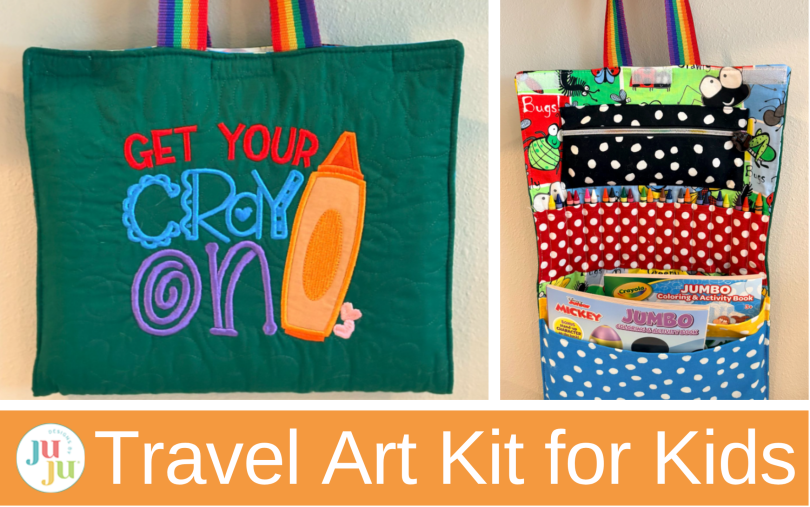
Make a DIY travel art kit for kids with embroidery, pockets, and a zipper pouch to keep crayons and coloring supplies organized for road trips, flights, and creative fun anywhere.
Every trip is more fun with a little creativity. Whether you’re on a road trip, waiting at the airport, or just need a quiet activity, this travel art kit keeps kids busy and sparks their imagination. It’s a handy and fun choice for creative kids on the go.
Finished size: 11” x 13” closed, 13” x 22” opened.
Check out the DBJJ team’s favorite supplies in the Designs by JuJu Amazon store. And for all your stabilizer and batting needs, be sure to check out Designs by JuJu+.

Begin by preparing the inside components.
Cut the inside lining to 14" x 23".
Cut four pockets measuring:

Fuse the prepared fusible interfacing to the wrong side of each pocket piece and the lining.

Fold over the long edge on each of the 14” pocket fabrics about ½”.

Press the fold.

Sew close to the edge to create a hem on each pocket.

Lay the zipper pouch fabric right side up. Place the zipper face down with the pull to the left along the raw edge. Clip in place.

Begin sewing ½” in from the side edge. Stop ½” from the opposite side edge. Sew close to the zipper.

Fold the other end of the fabric up to meet the other zipper edge. The zipper pull will still be to the left.

Clip the other side of the zipper tape and the second raw edge together.

Sew across close to the zipper. Remember to start ½” in from the edge and finish ½” from the opposite edge.

If needed, you can now trim the zipper to the edge of the fabric or slightly inside it.


Press the fabric so the zipper edge sits ½” down from the top of the pocket, as shown in the picture. Clip to hold in place. Open the zipper halfway.

Trim pocket sides to align, then sew both sides with a ½” seam allowance. Backstitch a few times to secure the zipper ends. Clip the corners.

Turn the zipper pocket right side out.

You should now have one zipper pouch, three pocket pieces, and the inside lining.

Lay the lining fabric right side up on a flat surface. Measure 12” from the bottom. Place the 14” x 4½” pocket right side down with the raw edge at the 12” mark and the side edges even.

Pin in place.

Sew a ¼” seam allowance across the raw edge.

Turn the pocket right side up and press.

Trim the sides of the pocket to be even with the lining, and sew down each side close to the edge.

With tailor’s chalk and a ruler, draw vertical lines 1” apart across the pocket.

Sew down each line to create the crayon pockets.

Measure from the top of the pocket up 1”. Place the bottom of the zipper pocket there.

Center zipper pocket and pin in place.

Sew close to the edge completely around the zipper pocket.

You now have the crayon pocket and zipper pocket attached.

Each pocket can hold two regular crayons.

Fold the opposite raw edge on the 14” x 7½” pocket over ¼” and sew a seam.

Fold the bottom of the lining up in the back to find the top-to-bottom mid-point that is the bottom of the bag.

Mark the mid-point with a pin.

Position the 14” x 7½” pocket just below mid-point, about ⅛” to ¼” lower. Do not place it above the middle mark, or your bag will not close properly.

Lay the final pocket down on top of the previous pocket, matching the raw edges on both sides and the bottom, and making sure the top hemmed edges are staggered.

Pin the two pockets to the lining.

Sew a ¼” seam down both sides.

Fold the lining in half and check to ensure the pockets are below the mid-point.

Coloring books, and sketch pads will slide nicely inside both pockets.
Once all the pockets are attached, set the lining aside and prepare the outer fabric.
Choose your quilting background and load the size you want to use. You’ll be quilting fabric that will later be cut into a 14” x 23” piece.

Cut the outside fabric to 16” x 25”. I cut my fabric larger to begin, in case the embroidery pulls it in slightly.

Fuse the prepared interfacing to the wrong side of the fabric.

Cut a piece of batting 35” x 22”. The batting will be our stabilizer, so there is no need for an additional stabilizer.

Hoop the batting into the hoop size you will be using. Spray with fabric adhesive.

Select the quilting design you want to use, and load the largest size for your hoop. Find the top left corner.

Load the hoop into the machine, and position the fabric onto the batting.

Smooth flat.

Begin the quilting design.

Continue quilting by repositioning the batting and fabric until the entire piece is quilted.

You may need to repeat this process depending on your hoop size. If you need additional help using the end-to-end quilting designs, check out this blog post: How to Align End-to-End Quilting Embroidery Designs.

When finished, remove the fabric from the hoop.

Trim away excess batting.

Fold your quilted fabric in half to locate the mid-point; this fold will become the bottom of your bag.

Mark the bottom of the bag with pins so it’s easy to reference as you work.

Next, mark the center of the fabric on the front side for design placement. This will help you position your embroidery just right. Choose designs that fit nicely on the front panel without extending below your bottom-of-the-bag pin, and be sure to leave about 4” to 5” of space at the top for trimming later.

Now for the fun part—selecting your designs! I used Art Glasses Applique paired with a phrase from Small Attitude Word Art 2 for the front. I went with the largest applique size and combined it with the smallest word art for a balanced, eye-catching design.

And for the back, I chose a design from Teacher Word Art.
Another cute option is the Art Glasses Girl Applique if you want a slightly different look.

Select the embroidery design or designs you wish to use.

Use the Design Placement keys to make sure the designs fit the front of the bag. Remember you do not want to go below the center pin marked for the bottom of the bag. My machine is a Brother 8500; your screen and keys may look different.

Once you are pleased with the placement, you can begin stitching.

If you are doing the applique, the first step is the fabric placement line.

Lay the fabric down, completely covering all the stitches.

Run the tack-down stitches and remove the hoop from the machine. Lay it flat and trim the fabric close to the stitches.

Return the hoop to the machine and continue stitching out all the applique pieces. Remember to trim each piece before moving on to the next.

Finish with the decorative satin edge.

If you want, you can follow the same steps to stitch out a design for the back of the bag.
When all the embroidery is finished, remove the fabric from the hoop to continue assembling the bag.

To trim the front of the bag, fold the fabric and mark the center bottom of the bag.
Repeat this process by folding the lining to mark its center as you did for the outer fabric. This ensures both layers align perfectly.

Match the center pins and the folded edge of the outer and lining fabric together.

Trim the outer fabric to match the lining.

Cut two 12"-long pieces of strapping for the handles. You can create your own handles if you prefer.

Measure in 4½” from both sides of the lining. Clip the end of the strapping to the edge of the lining's top. Do this on both the top and the bottom of the lining.

Sew across the straps close to the edge to hold them in place.

Clip the outside and lining together, right sides together, edges aligned, and straps tucked inside. Leave a 4” to 6” opening along one long side.

Sew a ¼” seam allowance around the entire bag. Sew slowly to ensure the edges stay aligned.
Clip the corners.

Turn the bag right side out through the opening. Press neatly, folding the opening inward. Clip the opening closed.

Topstitch around the entire bag, closing the opening.

Cut three strips of hook-and-loop tape, each 2” long.

Center one between the straps and place the other two at the ends, as shown in the picture. Sew one side of the tape in place.
Tip: Use a thread that matches your outside bag fabric for a clean look.

Clip the other side of the hook-and-loop tape pieces to the opposite end of the bag. Close the bag to check alignment before sewing them in place.

Your travel art kit is ready to fill with crayons, markers, and all kinds of creative supplies.


With just a few basic supplies, you can make a travel art kit that’s both fun and useful. It’s a great way to keep kids entertained and encourage creativity wherever you are. Pack it up, head out, and let their imaginations make every trip colorful!
Please share your travel kit in the Designs by JuJu Embroidery Blessings Group on Facebook, or use the hashtag #designsbyjuju anywhere on social media. As always, we love to see what you create!
Happy sewing!